
Mines Add Collision Avoidance Without Going Broke
Collision and fatigue-related incidents don’t discriminate by fleet size. They happen across operations of every scale. Yet for years, the safety technology capable of preventing them has carried enterprise price tags that put it out of reach for smaller contractors. The result has been an uncomfortable tradeoff that no operator should have to make: safety or solvency.
That tradeoff is now obsolete. AI has fundamentally changed what’s accessible and what’s possible for small and mid-tier mining operations:
- Incremental deployment: Start with a fleet management foundation and layer on safety modules as needs and budgets allow
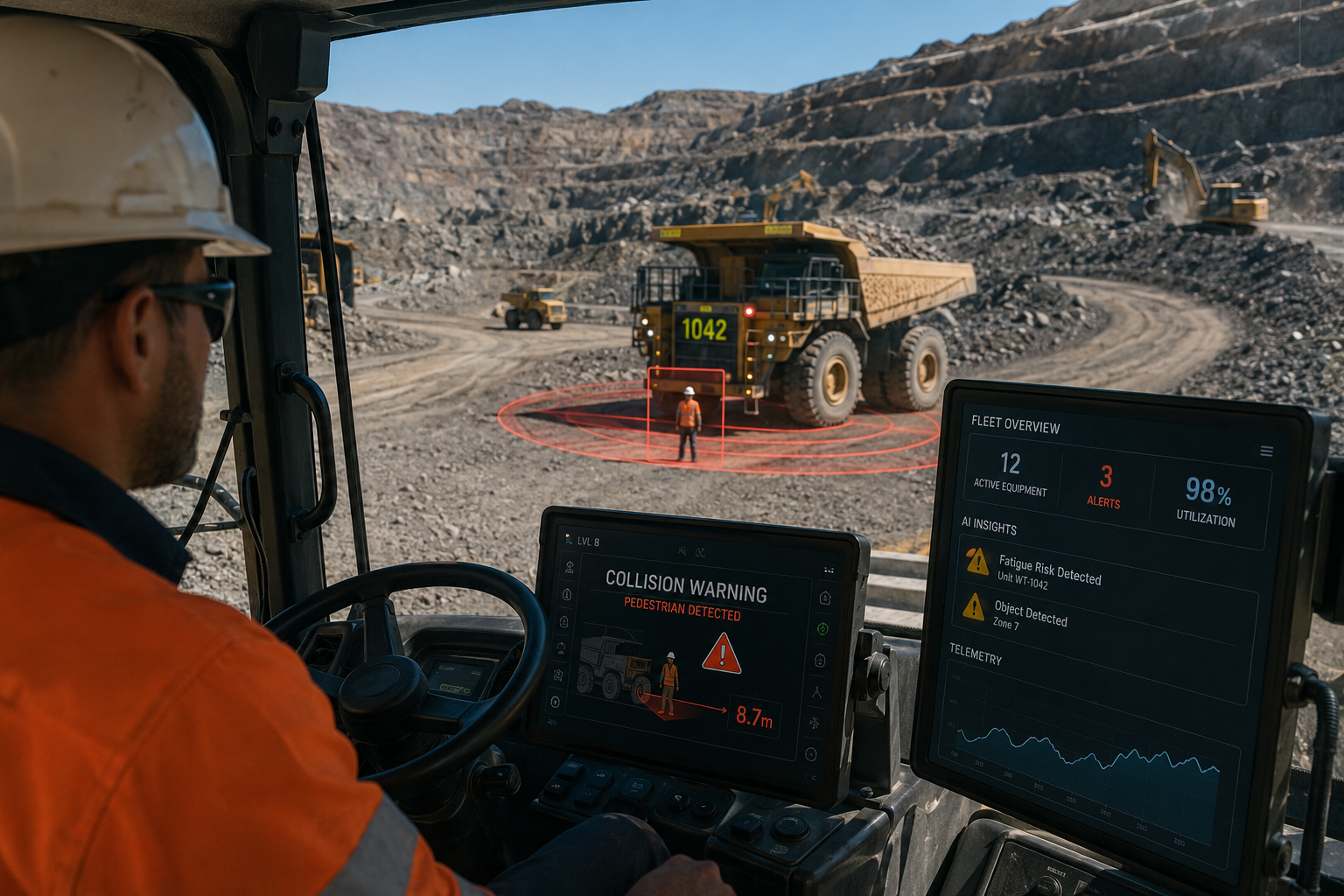
- Level 8 front-facing proximity detection: Intervention-grade collision warning, now accessible without a Tier-1 OEM contract
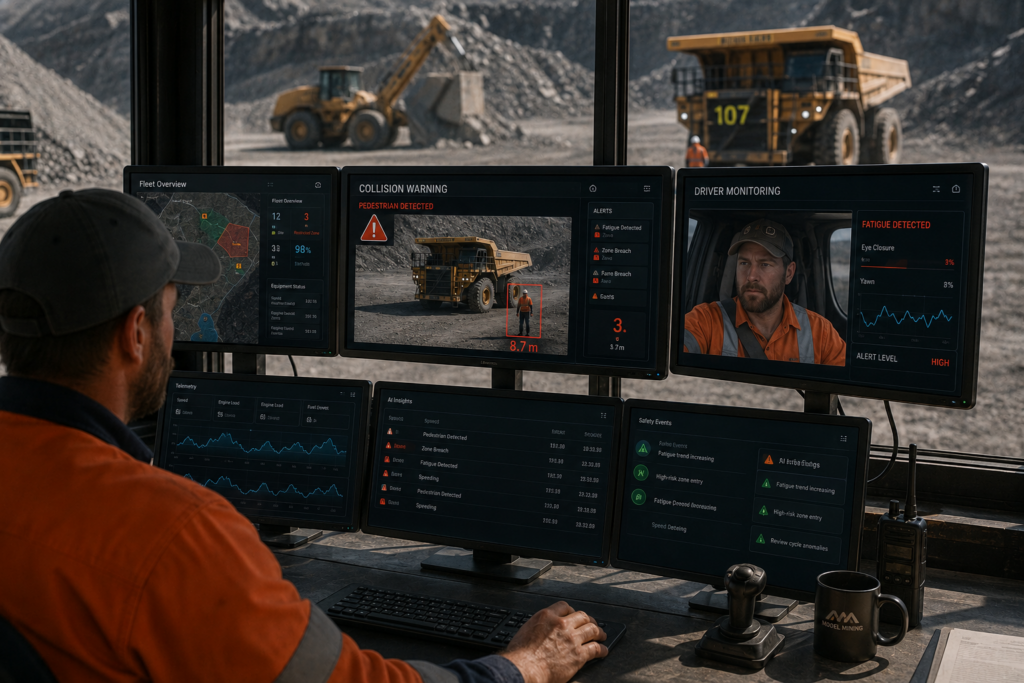
- AI-enhanced processes: From real-time object detection and driver fatigue monitoring to fleet telemetry analysis, AI handles the complexity so operators don’t have to
- Days, not months: Field-deployable systems built for contractors who can’t pause production for a 12-month integration
The Safety Gap in Small to Mid-Tier Mining
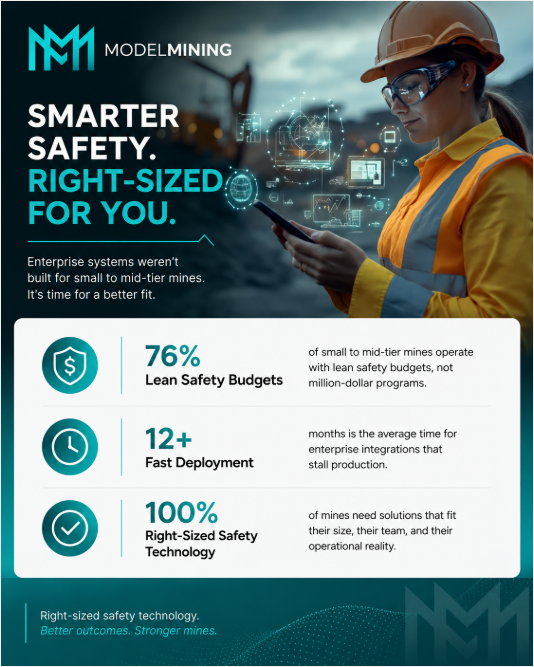
Smaller operators face the same hazards as the majors. Blind spots on haul trucks, operator fatigue across 12-hour shifts, fast-moving equipment in tight pit geometry, mixed light and heavy traffic. But unlike major mining operations, they don’t have:
- Million-dollar safety budgets or dedicated technology teams
- Time for 12-month integrations that stall production
- Right-sized safety technology options — until now.
AI-driven safety platforms have changed the equation to be affordable, customizable, and field-deployable in days, not months.
Safety Starts with Data
Before proximity sensors can flag a near-miss or driver monitoring can catch fatigue, something has to make sense of the raw data coming off your fleet. That’s the role of a fleet management system — and it’s why FMS isn’t just an operational tool. It’s the safety foundation everything else is built on.
SimpleFMS ingests continuous sensor data — position, speed, machine state, geofence status — and converts it into operational logic. That logic is what identifies risk in real time, automatically, without requiring a safety analyst to pull reports.
The safety intelligence is already there at the FMS layer:
- Zone speed violations detected automatically in hill descent and dump areas
- Geofence breaches flagged the moment equipment enters a restricted or downed zone
- Cycle anomalies that surface early indicators of operator fatigue or equipment fault
This matters because most smaller operations don’t realize how much safety visibility they’re leaving on the table before they ever add a proximity sensor or camera. It provides access to proximity detection, driver monitoring, and behavior analytics.
What Model Mining Delivers
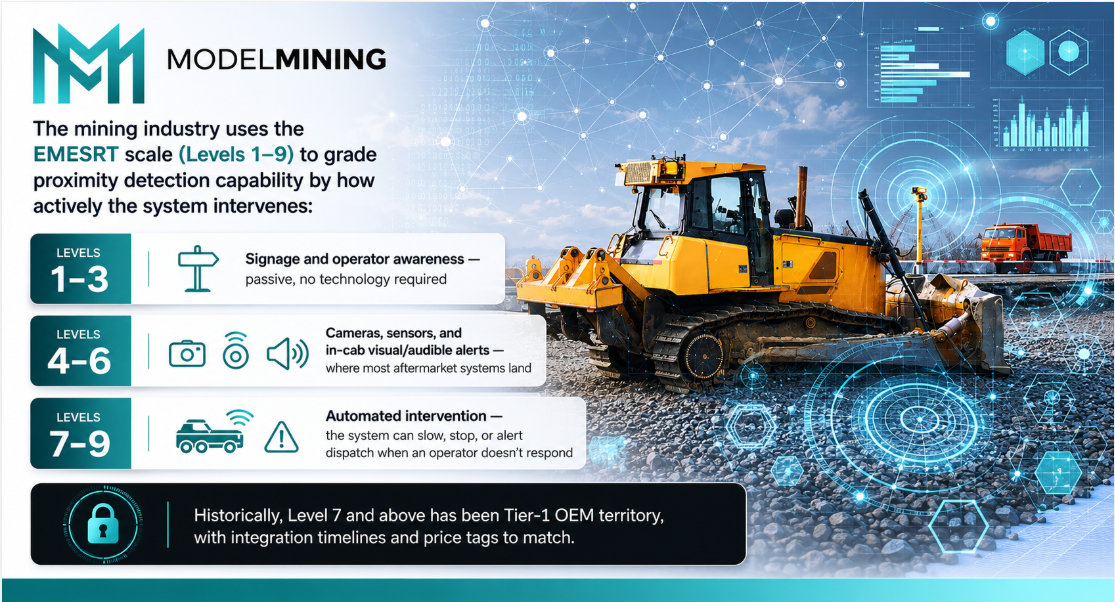
Smaller operations can now access Level 8 intervention-grade proximity detection without the enterprise procurement cycle.
Model Mining’s system uses AI-based image processing to analyze camera feeds in real time, fast enough to react within operationally meaningful time windows. Because it integrates directly with the SimpleFMS data layer, proximity events don’t just trigger an in-cab alert and disappear:
- Logged automatically with timestamp and location
- Correlated with shift data for pattern analysis
- Available for review by supervisors without manual data pulls
How AI Powers the Safety Stack
Model Mining uses AI to do something the market hasn’t seen at this price point: deliver Level 8 front-facing proximity detection — a Forward Collision Warning System (FCWS) — to operations that previously couldn’t access intervention-grade safety.
The AI layer is what makes it work:
- Real-time object detection from forward-facing camera feeds, processed fast enough to intervene within operationally meaningful time windows
- Driver monitoring — fatigue and distraction detection running locally in the cab, with low-latency alerts before risk becomes incident
- Sensor data analysis — converting raw fleet telemetry into actionable safety logic across the entire operation
The result is a safety stack that would have required a Tier-1 OEM contract two years ago, now deployable on a smaller fleet without the enterprise timeline or price tag.
That's right-sized Safety Technology Built for the Underdog
SimpleFMS, and our forward collision warning system, proximity detection, and driver monitoring were built for operators who want easy-to-use, modern, AI-driven safety solution.
Ready to See What Fits Your Fleet?
Schedule a demo, and we’d be happy to walk through which safety modules make sense for your operation, what rollout looks like, and what it costs.